Originally published July 2025 — updated July 2026 to reflect the current vibe coding tool landscape and where the space has moved since.
What Is Vibe Coding and Why Developers Can’t Ignore It in 2026
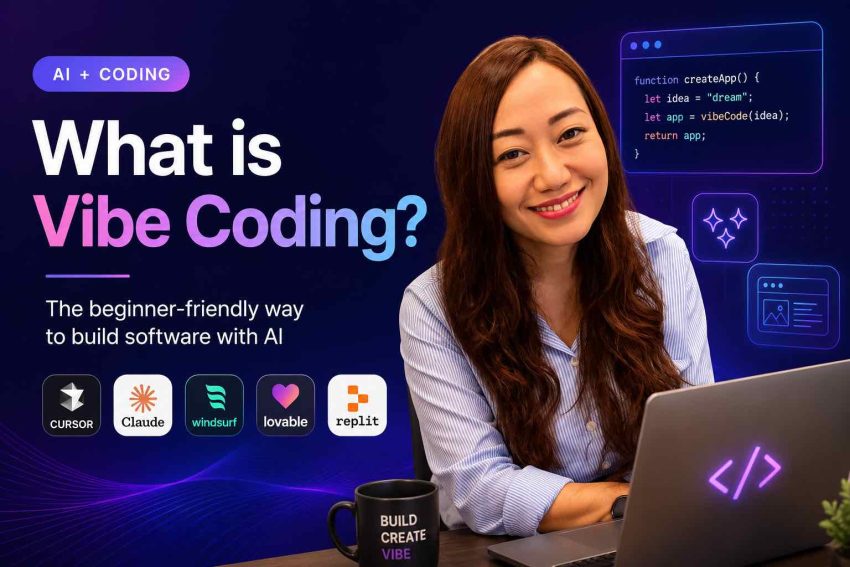
What Is Vibe Coding?
If you’ve ever caught yourself thinking, “Can I just tell the AI what I want and skip the boilerplate?”
You’re already halfway into vibe coding.
Vibe coding is an LLM-powered approach to development where you describe what you want in natural language, and AI helps build it. You’re not micromanaging lines of syntax anymore. You’re collaborating with a machine that understands your goals, iterates with you, and keeps you in creative flow.
In short: you guide the vibe, and the code follows.
💡 So, What Is Vibe Coding?
Vibe coding is an improvisational, AI-assisted development style where you “code by vibes.” That means you describe outcomes, nudge the AI’s output, and iterate like you’re having a conversation. The syntax? Handled. The structure? Suggested. Your job? Stay in the driver’s seat and steer the solution forward.
It’s like having a very smart intern who doesn’t sleep and takes direction well.
🔥 Where the Term Came From
The phrase hit the mainstream in early 2025 when AI researcher Andrej Karpathy tweeted about “fully giving in to the vibes… and forgetting that the code even exists.”
That one tweet lit up X, Reddit, and Dev.to. Community experiments followed, and “vibe coding” started showing up in changelogs of cutting-edge developer tools. By 2026, it had moved well past novelty status — Collins Dictionary named it Word of the Year, and search interest in the term spiked over 6,000%. What started as a tweet became a legitimate development methodology in under two years.
⚙️ How Vibe Coding Works — Step by Step
Here’s how it typically unfolds:
1. Prompt Your Idea
Type or say what you want, like:
“Build a Flask API that returns GPT-generated trivia questions.”
2. Let the AI Generate
Your AI tool drafts the code, docs, and sometimes even tests. You scan, revise, or give follow-up prompts:
“Add rate-limiting middleware”
“Make it async”
“Add error handling for 429s”
3. Human Review
You test, fix edge cases, document what matters, and ship.
🧰 The 2026 Vibe Coding Tool Stack
The tooling landscape has split into two clear camps: AI app builders that generate and host complete applications for you, and AI coding assistants that sit inside a dev environment and help you write and ship code faster.
| Tool | Vibe-First Feature |
|---|---|
| Claude Code | Terminal-native agent, deep codebase-wide reasoning, plan-then-execute workflow |
| Cursor | AI-native IDE, strongest all-purpose tool for developers who want a visual editor |
| Lovable / Bolt.new | Prompt-to-deployed-app, no coding knowledge required |
| Replit Agent | Autonomous end-to-end building with built-in hosting, browser-only |
| Windsurf | Fast-rising AI IDE closing the gap on Cursor |
🚀 Why Developers Are Leaning In
Vibe coding isn’t a novelty—it’s a workflow advantage. Here’s why devs are adopting it fast:
- Speed: Teams report meaningfully faster feature delivery, though the gains vary a lot depending on project complexity and how disciplined the review process is.
- Accessibility: Non-engineers with domain knowledge can now build usable prototypes.
- Creative Flow: Fewer context switches mean more focus on the what, not the how.
- Experimentation: Try bold ideas without a heavy time penalty.
- Career Advantage: AI-fluent developers who know how to direct these tools well are increasingly valued over those who don’t.
⚠️ What to Watch Out For
Like any tool, vibe coding comes with trade-offs:
- Hallucinated Logic – AI might generate code that looks right but fails in edge cases.
- Security Holes – Auto-generated code might bypass your usual compliance practices.
- Poor Documentation – Without human annotations, code clarity suffers.
- Ethical Ambiguities – Who owns AI-generated code? What happens to junior dev training?
This isn’t a full handoff—it’s a co-pilot. Keep your eyes open.
💻 Real-World Use Cases
Vibe coding isn’t just for labs and tech demos. Here’s where it’s showing up today:
- Weekend MVPs – Solo founders ship SaaS tools with voice-note transcription, AI search, and chatbots.
- Ops Automation – Fintech teams automate log triage and workflow triggers.
- Hackathons & Classrooms – Students build Python games in hours.
- SaaS Launch Kits – Indie makers spin up marketing sites and payment integrations in one sitting.
🧭 How to Adopt Vibe Coding (Without Breaking Stuff)
Start smart. Here are the best practices to keep things stable as you explore:
- Craft Clear Prompts – “Return a JSON array of 3 trivia questions” works better than “make a thing.”
- Keep Humans in the Loop – Always peer review, especially before shipping to prod.
- Commit Wisely – Break up AI-suggested diffs with readable commit messages.
- Pilot It First – Use vibe coding on internal tools or safe features before core modules.
🆚 Vibe Coding vs. Traditional Programming
| Factor | Vibe Coding | Traditional Coding |
|---|---|---|
| Speed | Hours–Days | Days–Weeks |
| Expertise Needed | Moderate | High |
| Reliability | Needs Review | Predictable |
| Scalability | Growing | Proven |
| Best For | Prototypes, UI tweaks | Core infra, critical code |
🔮 What’s Actually Happened Since 2025 — and What’s Next
- Agentic dev chains — confirmed. The market has split cleanly into AI app builders (Lovable, Bolt, Replit) that generate whole apps and manage hosting, and AI coding assistants (Cursor, Claude Code) that work inside real code you edit yourself.
- Domain-specific tools are emerging, though general-purpose tools still dominate day-to-day use.
- The real challenge in 2026 isn’t whether to use AI to code — it’s choosing the right tool for the job. A tool built for a senior engineer working on a complex codebase is a poor fit for a student’s first project, and vice versa. Picking the wrong one slows you down rather than speeding you up.
🎯 Final Thoughts: Ride the Vibe
This isn’t about AI replacing devs. It’s about amplifying what you can do.
Vibe coding puts you in the role of creative conductor—not code typist. You sketch the vision, AI builds the first draft, and you refine it into something real. That’s not just productivity—that’s power.
If you’re curious? Start small. Experiment safely. Then go build something your past self would’ve taken weeks to finish.
The future is shipping fast. Ride the vibe. 🚀
❓ FAQs
Is vibe coding only for beginners?
Not at all. Senior engineers use it to offload repetitive work and focus on architecture, logic, and user experience. The tools favored by experienced developers require more technical fluency than the no-code app builders aimed at beginners.
Which tool should I actually use?
It depends on whether you can code. If you can, agent-style tools that work inside your existing codebase tend to produce the highest code quality. If you can’t, prompt-to-app builders that also handle hosting are the better entry point — you trade some control for speed and accessibility.
Which languages are best for vibe coding?
Languages with rich LLM training data — Python, JavaScript, TypeScript, Go — still perform best regardless of which tool you pick.
Can vibe coding replace developers?
Not anytime soon. AI can assist, but humans are still essential for logic, strategy, security, and system design.
How do I secure AI-generated code?
Run static analysis tools, enforce peer reviews, and check for licensing or dependency vulnerabilities. This remains the single most-skipped step by teams moving fast.
What setup do I need?
Depends on your path: a modern IDE plus an AI plugin for developers, or just a browser and an account for no-code builders.
🌟 What Is Vibe Coding For Me?
Vibe coding isn’t just a tech trend. It’s a new rhythm for how we create with AI—faster, freer, and more intuitive than ever.
If you’re a developer, a founder, or someone simply curious about where the future’s headed, my advice is simple: start playing with it. Don’t wait for perfect. Start small, keep it safe, and stay curious.
I write about AI workflows, emerging tech, and the future of content creation at The SEO Content Queen. If this sparked something for you, connect with me on LinkedIn.
Let’s build the future—one prompt at a time.