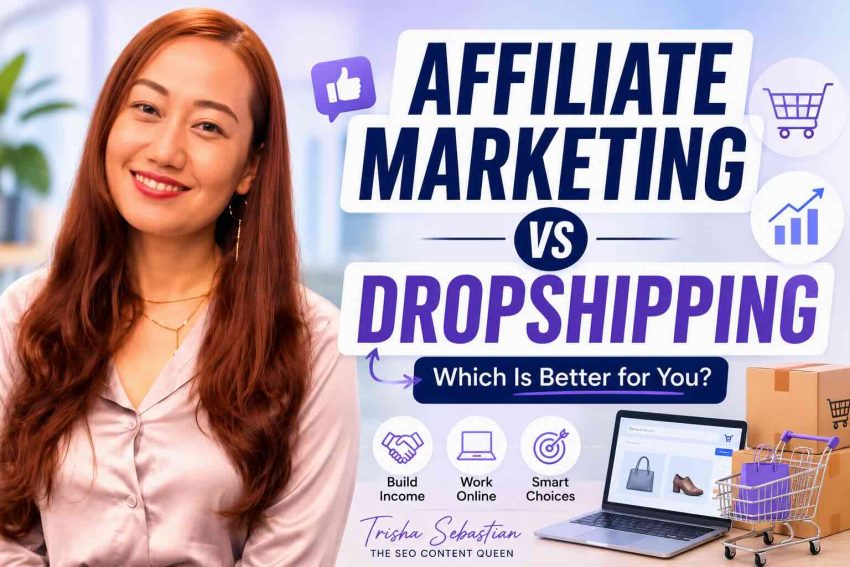
Affiliate Marketing vs Dropshipping: Which Business Model Is Better?
Affiliate marketing and dropshipping are two of the most popular ways to start an online business—but they work very differently.
Both let you build a business without creating your own products from scratch. Both have relatively low startup costs. And both have helped entrepreneurs build six- and even seven-figure businesses.
But after years of working in SEO and helping businesses grow through organic search, I’ve noticed something important:
Most people choose the wrong business model because they’re focused on making money quickly instead of building a business that lasts.
If you’re comparing affiliate marketing vs dropshipping, this guide will help you understand the differences so you can choose the business model that best fits your goals, budget, and skills.
Affiliate Marketing vs Dropshipping: Quick Answer
If you’re looking for long-term passive income and enjoy creating content, affiliate marketing is usually the better choice.
If you prefer running an online store, managing products, and scaling through paid advertising, dropshipping may be a better fit.
Both business models can be profitable, but they require different strategies, different skill sets, and different expectations.
Let’s take a closer look.
What Is Affiliate Marketing?
Affiliate marketing is a business model where you earn a commission by recommending someone else’s products or services.
Instead of creating your own products, you refer customers through a unique affiliate link. When someone makes a purchase using your link, you earn a commission.
Many affiliate marketers generate traffic through:
- Blogs
- YouTube
- Email newsletters
- Social media
- Podcasts
Popular affiliate programs include:
- Amazon Associates
- Impact
- PartnerStack
- ShareASale
- ClickBank
One of the biggest advantages is that you never have to worry about inventory, shipping, or customer support.
Pros of Affiliate Marketing
- Low startup costs
- No inventory required
- No customer service
- Passive income potential
- Can be built around your expertise
- Content continues generating traffic over time
Cons of Affiliate Marketing
- Takes time to build traffic
- Income depends on commission rates
- Merchants can change their affiliate programs
- Requires consistent content creation
What Is Dropshipping?
Dropshipping is an ecommerce business model where you sell physical products without keeping inventory.
When a customer places an order, your supplier ships the product directly to them.
Instead of earning commissions, you make money from the difference between your selling price and your supplier’s cost.
Popular ecommerce platforms include:
- Shopify
- WooCommerce
- BigCommerce
Popular suppliers include:
- AutoDS
- Spocket
- Printful
- CJ Dropshipping
Pros of Dropshipping
- Low startup costs
- No inventory management
- Greater control over pricing
- Opportunity to build your own ecommerce brand
- Faster revenue potential with successful advertising
Cons of Dropshipping
- Lower profit margins
- Customer support responsibilities
- Shipping delays
- Product quality depends on suppliers
- Often requires paid advertising to scale
Affiliate Marketing vs Dropshipping: Side-by-Side Comparison
| Feature | Affiliate Marketing | Dropshipping |
|---|---|---|
| Startup Cost | Very Low | Low |
| Inventory | None | None |
| Customer Service | No | Yes |
| Profit Model | Commission | Product Markup |
| Risk | Low | Moderate |
| SEO Potential | Excellent | Good |
| Passive Income | High | Moderate |
| Scalability | High | Very High |
| Upfront Investment | Minimal | Store + Apps + Marketing |
Affiliate Marketing vs Dropshipping: Startup Costs
One reason both business models are popular is their relatively low startup costs.
Affiliate marketing is typically the less expensive option. In many cases, you can start with a website and begin promoting affiliate products without purchasing inventory.
Dropshipping also eliminates the need to buy inventory upfront, but you’ll usually need to pay for an ecommerce platform, premium apps, product sourcing tools, and often paid advertising to attract customers.
If you’re starting with a limited budget, affiliate marketing generally has the lower financial barrier to entry.
Affiliate Marketing vs Dropshipping: Which Is More Profitable?
Profitability depends largely on how you generate traffic.
If you’re relying heavily on paid advertising, dropshipping can produce revenue faster.
However, paid advertising comes with ongoing costs. The moment you stop running ads, your traffic often stops too.
Affiliate marketing usually takes longer to build because you’re investing in content instead of immediate sales.
But once your content ranks in search engines—or is recommended by AI assistants—it can continue generating commissions for months or even years.
That’s why many affiliate marketers eventually build more predictable long-term income.
Affiliate Marketing vs Dropshipping: Which Is Better for SEO?
This is where my experience in SEO comes in.
If your goal is to generate free, long-term traffic from Google and AI search, affiliate marketing has a significant advantage.
Every article, review, tutorial, and comparison you publish becomes a long-term asset.
Instead of paying for every visitor, your content can attract people through:
- Google Search
- Google AI Overviews
- ChatGPT
- Perplexity
- Claude
- Bing Copilot
Over time, your website becomes more authoritative as you consistently publish helpful content within your niche.
A dropshipping store can certainly rank in search results, but ecommerce sites often rely more heavily on product pages and paid advertising, making long-term organic growth more challenging.
How AI Has Changed Both Business Models
Artificial intelligence has transformed both affiliate marketing and dropshipping.
Today, AI can help affiliate marketers:
- Research keywords
- Generate content outlines
- Improve SEO
- Write email campaigns
- Create comparison tables
- Analyze competitors
Dropshipping businesses can use AI for:
- Product descriptions
- Customer support
- Ad copy
- Product research
- Email automation
- Image generation
While AI makes both business models easier to manage, it doesn’t replace strategy.
The businesses that succeed are the ones that combine AI with genuine expertise, helpful content, and a great customer experience.
Affiliate Marketing vs Dropshipping: Which Is Better for Beginners?
If you’re just starting your online business journey, both models are worth considering.
Choose Affiliate Marketing If:
- You enjoy creating content.
- You want long-term passive income.
- You prefer SEO and organic traffic.
- You don’t want to deal with customers.
- You have patience to build a long-term asset.
Choose Dropshipping If:
- You want to build an ecommerce brand.
- You enjoy testing products.
- You’re comfortable running paid advertising.
- You don’t mind handling customer service.
- You want the potential for faster sales.
My Recommendation After Years in SEO
If I were starting today with limited money, I would build an affiliate marketing website first.
Why?
Because content becomes an asset.
A well-written article can continue attracting visitors through search engines and AI assistants long after it’s published.
I’ve seen firsthand how powerful SEO compounds over time. Unlike paid ads, where traffic stops the moment you stop spending, evergreen content continues working for you day after day.
Once your affiliate website begins generating consistent income, you can always use those profits to launch a dropshipping business if ecommerce still interests you.
For many entrepreneurs, affiliate marketing provides a stronger long-term foundation.
Can You Combine Affiliate Marketing and Dropshipping?
Absolutely.
In fact, many successful entrepreneurs combine both business models.
For example, you could:
- Build an SEO-driven blog
- Recommend affiliate products
- Launch your own ecommerce store
- Cross-promote products across both businesses
This creates multiple income streams while reducing your dependence on a single business model.
Final Verdict
There isn’t a universal winner in the affiliate marketing vs dropshipping debate.
Both business models can be profitable.
If your priority is fast growth through paid advertising, dropshipping may help you generate revenue sooner.
If your goal is building a sustainable business powered by content, SEO, and AI search, affiliate marketing offers stronger long-term potential.
Ultimately, the better business model is the one that matches your strengths, budget, and long-term goals.
Personally, I believe investing in content first creates a more durable online business—especially as search continues evolving with AI.
Whichever path you choose, focus on creating value first. Businesses built on helping people tend to last much longer than businesses built solely around chasing quick profits.
Frequently Asked Questions
Is affiliate marketing better than dropshipping?
It depends on your goals. Affiliate marketing is generally better for long-term passive income, while dropshipping can generate faster sales if you’re willing to invest in advertising.
Which is easier to start?
Affiliate marketing is typically easier because you don’t need to manage an online store, inventory, or customer support.
Can I do affiliate marketing and dropshipping together?
Yes. Many entrepreneurs build an affiliate content website while also running an ecommerce store to diversify their income streams.
Which business model has less risk?
Affiliate marketing generally carries less financial risk because there are no inventory costs, shipping issues, or customer service responsibilities.
Related Articles
Continue learning with these guides:
- Best AI Tools You Can’t Ignore
- How to Get a Google Knowledge Panel
- AI for LinkedIn
- How AI Is Changing SEO
About the Author
Hi, I’m Trisha Sebastian, also known as The SEO Content Queen.
I help entrepreneurs grow their businesses through SEO, AI, and content marketing. On this blog, I share practical strategies, tutorials, and honest comparisons to help you build sustainable online businesses that continue growing as search evolves.