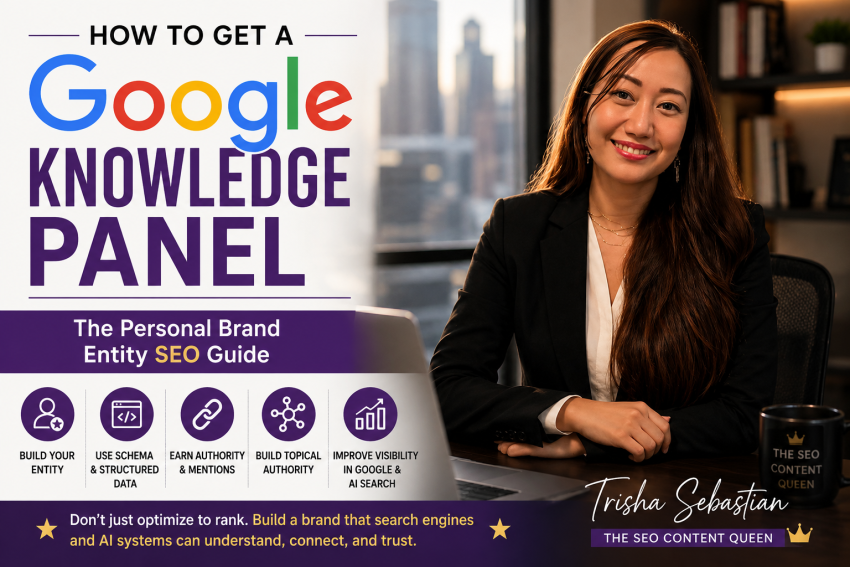
How to Get a Google Knowledge Panel: The Personal Brand Entity SEO Guide
You Google your name.
Maybe your website appears. Your LinkedIn profile shows up. Your social media accounts are scattered across the results.
But on the right side of Google?
Nothing.
No Knowledge Panel. No neatly organized information about who you are, what you do, or why you matter.
Meanwhile, you search for another entrepreneur, consultant, author, creator, or industry expert—and Google seems to know exactly who they are.
So what gives?
Here’s the good news:
You do not necessarily have to be famous to become an entity that Google understands.
But getting a Google Knowledge Panel is also not as simple as filling out a form and asking Google to create one for you.
The real goal is bigger:
You need to build enough clear, consistent, and corroborated information across the web that Google can confidently understand who you are as a distinct entity.
And today, that matters far beyond Google.
The same work that helps search engines understand your identity can also strengthen how your personal brand is discovered, interpreted, and referenced across AI-powered search and answer engines.
So instead of thinking:
“How do I get a Google Knowledge Panel?”
I want you to think:
“How do I become an entity that search engines and AI systems can clearly understand?”
That is the real game.
Let’s break it down.
What Is a Google Knowledge Panel?
A Google Knowledge Panel is the information box that may appear in Google Search when Google recognizes a person, organization, place, or other subject as a distinct entity.
For a person, it may include information such as:
- Your name
- Your photo
- Your occupation
- A short description
- Your website
- Social profiles
- Books, companies, or other associated entities
- Other facts Google has connected to you
The important thing to understand is that a Knowledge Panel is not simply another search result.
It is a reflection of Google’s understanding of an entity.
Google is essentially trying to answer:
- Who is this person?
- Is this person distinct from other people with similar names?
- What are they known for?
- Which sources describe them?
- Which website and profiles actually belong to them?
- What other people, companies, topics, and entities are they connected to?
- How confident are we that all of this information refers to the same person?
That last question—confidence—is where entity SEO becomes important.
You Don’t Need to Be Famous, But You Do Need to Be Understandable
One of the biggest misconceptions about Google Knowledge Panels is that they are reserved only for celebrities and globally famous people.
Prominence can certainly help. The more notable a person is, the more likely there will be authoritative information about them across the web.
But fame is not the only factor.
Google also needs clarity, consistency, and corroboration.
Imagine finding five different profiles for the same person.
One says:
SEO consultant.
Another says:
Content marketer.
Another says:
Entrepreneur.
Another uses a different version of the person’s name.
The personal website barely explains who the person is.
None of the profiles clearly connect to one another.
From a human perspective, you may be able to figure out that they all refer to the same person.
But a search engine has to determine that algorithmically.
Now compare that with someone who has:
- A clearly defined personal website
- A consistent professional name
- A strong About page
- Consistent biographies across authoritative platforms
- Structured data connecting their website and profiles
- Relevant third-party mentions
- Clear associations with their companies, topics, publications, and areas of expertise
The second person is easier to understand as an entity.
And that is the foundation of personal entity SEO.
What Is Entity SEO?
Traditional SEO often begins with keywords.
Entity SEO begins with things.
A keyword is a word or phrase someone searches for.
An entity is a distinct person, organization, place, product, concept, or other identifiable thing.
For example:
“SEO content queen” could simply be interpreted as a phrase.
But “Trisha Sebastian” can potentially be understood as a specific person with relationships to:
- A personal website
- A professional title
- A company
- Social profiles
- Published content
- Areas of expertise
- Other people and organizations
Entity SEO is about helping search engines understand those relationships.
For a personal brand, you want search engines to become increasingly confident about questions such as:
Who are you?
What are you known for?
What is your official website?
Which profiles belong to you?
What topics are you genuinely associated with?
Which organizations are you connected to?
Which third-party sources corroborate these facts?
The clearer the answers become, the stronger your entity can become.
A Knowledge Panel Is the Result, Not the Strategy
This is one of the most important distinctions in this entire guide.
Do not make the Knowledge Panel itself your entire strategy.
A Knowledge Panel is a visible outcome that may appear when Google has enough confidence in its understanding of an entity.
Your actual strategy should be to build a strong, consistent, well-corroborated digital identity.
Think of it this way:
Weak strategy:
I want a Knowledge Panel.
Better strategy:
I want Google and other discovery systems to confidently understand who I am, what I am known for, and which information about me is authoritative.
That second goal can benefit you even before a Knowledge Panel appears.
It can strengthen your overall branded search presence and create a clearer digital footprint for both humans and machines.
How to Get a Google Knowledge Panel: Build the Entity First
There is no guaranteed checklist that forces Google to create a Knowledge Panel.
But there are practical steps you can take to make your personal brand easier to identify and understand.
1. Decide Exactly Who You Are Online
This sounds obvious.
It isn’t.
Many personal brands are surprisingly inconsistent.
Before trying to strengthen your entity, define your core identity.
Ask yourself:
- What professional name do I consistently use?
- What am I primarily known for?
- What is my primary website?
- What title or positioning do I use?
- Which topics do I want to be associated with?
- Which organizations or companies am I legitimately connected to?
You do not need to use the exact same sentence everywhere.
In fact, copying and pasting an identical bio across the entire web can feel unnatural.
But the underlying facts should be consistent.
For example, if one platform describes you as an SEO strategist, another as a content marketing expert, and another as a Search Everywhere Optimization specialist, those descriptions can coexist.
The problem begins when your digital footprint becomes contradictory rather than complementary.
Consistency does not mean duplication. It means alignment.
2. Create an Entity Home on Your Own Website
Your personal website should become the central source of truth about you.
This is sometimes referred to as an entity home.
For most personal brands, the strongest candidate is a dedicated About page.
Your entity home should clearly establish:
- Your full professional name
- A clear description of who you are
- What you do
- What you are known for
- Your areas of expertise
- Your professional history where relevant
- Companies or organizations you are associated with
- Your official social profiles
- Your publications, appearances, or other important work
The goal is not to stuff the page with every fact about your life.
The goal is to create one clear, authoritative page that helps both people and machines understand your professional identity.
Your website should not leave Google guessing.
3. Make Your About Page Actually Useful
A surprising number of personal brand websites have weak About pages.
They may contain a few vague sentences such as:
“I help people achieve their dreams and unlock their potential.”
That may sound inspiring.
But what does it actually tell a search engine—or a potential client—about who you are?
A strong About page should answer concrete questions.
For example:
- Who is this person?
- What is their profession?
- What are they known for?
- What topics do they have expertise in?
- What companies or projects are associated with them?
- Where else can their identity be verified?
Be specific.
Specificity creates clarity.
Instead of:
“Trisha is a digital marketing expert.”
A stronger description might explain the specific areas in which Trisha works, such as SEO, content strategy, entity optimization, AI-powered search visibility, and Search Everywhere Optimization.
The more precise your positioning is, the easier it becomes to build consistent associations between you and the topics you want to own.
4. Add Person Schema to Your Website
Structured data can help search engines understand the information on a page.
For a personal brand, Person schema can provide structured information about who you are.
Depending on what is accurate and relevant, your structured data may include properties such as:
nameurlimagejobTitledescriptionsameAsworksForalumniOfknowsAbout
However, schema is not magic.
Adding Person schema does not automatically generate a Knowledge Panel.
Think of structured data as another layer of clarity.
It helps explicitly communicate information that should already be supported by the visible content on your website and by your broader digital footprint.
Schema should describe reality—not manufacture it.
5. Use sameAs to Connect Your Official Profiles
One of the challenges of building a personal entity is helping search engines understand which profiles across the web belong to the same person.
The sameAs property can help connect your entity home with your official profiles on other platforms.
Depending on your actual presence, these may include profiles on platforms such as:
- YouTube
- X
- GitHub
- Other authoritative industry or professional platforms
Again, the goal is not to create profiles everywhere just to have more links.
The goal is to connect legitimate, maintained profiles that genuinely represent you.
Think of your digital presence as a network.
Your website is the hub.
Your official profiles are connected nodes.
The clearer those relationships are, the easier your digital identity becomes to understand.
6. Keep Your Identity Consistent Across the Web
Search your own name.
Seriously.
Look at what appears.
Then audit the information.
Check:
- Your name
- Profile photos
- Professional titles
- Bios
- Company associations
- Website links
- Social links
You do not need to make every profile identical.
But you should correct outdated or conflicting information wherever possible.
This is especially important if:
- You have changed careers
- You have changed companies
- Your positioning has evolved
- You use multiple versions of your name
- Old biographies still dominate your search results
Entity building is partly about creating new signals.
It is also about cleaning up confusing ones.
7. Build Topical Authority Around What You Want to Be Known For
You cannot simply declare expertise and expect search engines to accept it.
You need evidence.
If you want to be strongly associated with SEO, publish meaningful work about SEO.
If you want to be known for entity optimization, demonstrate expertise in entity optimization.
If you want to own a specific niche, create a body of work around that niche.
This is where content strategy and entity SEO intersect.
Your content can reinforce the relationship between:
Your name → your expertise → your topics → your body of work
One article will rarely establish that relationship.
A sustained body of useful, interconnected content is much stronger.
For example, someone building authority around Search Everywhere Optimization might publish content about:
- Traditional SEO
- Entity SEO
- Google Knowledge Panels
- AI search optimization
- Brand mentions
- Digital PR
- Structured data
- Knowledge graphs
- Topical authority
- Content distribution
- YouTube search
- Social search
- Answer engines
Over time, the relationships between the person and these topics become clearer.
8. Earn Third-Party Corroboration
Your website can say anything about you.
That is why third-party corroboration matters.
Search engines can gain additional confidence when independent, credible sources consistently confirm important facts about a person.
Depending on your industry, this may come from:
- Interviews
- Podcasts
- Conference speaker pages
- Professional associations
- Company leadership pages
- Guest articles
- Expert contributions
- Reputable media coverage
- Industry publications
- Books and author pages
- Awards or recognized directories
The key word is credible.
Ten low-quality profile pages created only for SEO are not necessarily more valuable than one genuinely authoritative source.
Do not chase mentions simply because they create a backlink.
Think beyond links.
Ask:
Does this source help corroborate who I am and what I am known for?
That is a different standard.
9. Build Relationships Between Your Entity and Other Recognized Entities
Entities do not exist in isolation.
They are understood partly through relationships.
A person may be connected to:
- A company
- A university
- A book
- An event
- An organization
- A profession
- A topic
- Other people
These relationships can help create context.
For example, if you are legitimately a founder, employee, speaker, author, or contributor, those connections should be represented accurately across the relevant websites and profiles.
The important word here is legitimately.
Entity SEO is not about inventing associations.
It is about making real relationships easier to understand.
10. Strengthen Your Branded Search Results
Your Google results page for your own name is one of the best places to evaluate your digital identity.
Search for:
- Your full name
- Your name + profession
- Your name + company
- Your name + primary topic
- Your brand name or professional moniker
Then ask:
- Does my official website rank prominently?
- Are my correct social profiles visible?
- Do the results accurately represent who I am today?
- Are there outdated pages creating confusion?
- Is my expertise obvious from the search results?
- Does another person with the same name dominate the results?
You can think of branded search as your digital front door.
Before obsessing over whether you have a Knowledge Panel, make sure the rest of the search results tell a coherent story.
What About Wikipedia and Wikidata?
This is where people can get themselves into trouble.
Many people assume the fastest path to a Knowledge Panel is to create a Wikipedia page for themselves.
That is not how Wikipedia works.
Wikipedia has its own standards, including requirements around notability, reliable independent sourcing, neutrality, and conflicts of interest.
A Wikipedia page should not be treated as a personal branding asset that you simply create because you want a Knowledge Panel.
The same principle applies to other knowledge bases.
Do not create inaccurate, promotional, or unsupported information simply to manipulate entity recognition.
If you genuinely qualify for inclusion in a platform, follow its rules.
If you do not, focus on building a legitimate body of work and credible digital footprint.
Build the reality first. Document it second.
Can You Pay Someone to Get You a Google Knowledge Panel?
Be careful with anyone who guarantees that they can get you a permanent Google Knowledge Panel.
No legitimate consultant can control Google’s systems or guarantee that a panel will appear and remain indefinitely.
Someone may be able to help you:
- Audit your entity presence
- Improve your website
- Implement structured data
- Consolidate your profiles
- Identify inconsistencies
- Develop a digital PR strategy
- Strengthen third-party corroboration
- Improve your branded search presence
Those are legitimate services.
But:
“Pay me and I guarantee Google will give you a permanent Knowledge Panel”
should make you cautious.
The goal should be to improve the underlying signals—not manufacture the appearance of authority.
How Long Does It Take to Get a Google Knowledge Panel?
There is no universal timeline.
For some entities, Google’s understanding may develop relatively quickly because strong signals already exist.
For others, it may take months or longer.
And some people may build a strong digital presence without receiving the exact Knowledge Panel they expected.
That is why I do not recommend measuring the success of your entire entity SEO strategy by one feature.
Instead, look for broader signs of progress:
- Your website ranks more consistently for your name
- Search results become cleaner and more accurate
- Your official profiles are easier to find
- Your name becomes more strongly associated with your expertise
- Your content earns citations and mentions
- Search engines connect you with the correct organizations and topics
- AI systems describe you more accurately and consistently
A Knowledge Panel can be valuable.
But a strong entity is bigger than a box on Google.
Knowledge Panels in the Age of AI Search
This is where the conversation becomes even more interesting.
People are no longer discovering experts, brands, and businesses only through a traditional list of ten blue links.
They are also asking questions through:
- AI-powered search experiences
- Answer engines
- Large language models
- Social platforms
- Video platforms
- Communities
- Recommendation systems
This changes the visibility landscape.
The question is no longer only:
“Can I rank for this keyword?”
It is also:
“Do these systems understand who I am?”
“Do they associate me with the right topics?”
“Can they find consistent, credible information about me?”
“Am I mentioned in the sources and conversations they rely on?”
“When someone asks for an expert in my category, am I even part of the consideration set?”
This is why I believe entity building is becoming increasingly important.
Your digital presence is no longer being interpreted by one search engine in one format.
Your brand is being discovered across an entire ecosystem.
From SEO to Search Everywhere Optimization
Traditional SEO is still important.
Google still matters.
Your website still matters.
Keywords still matter.
Links still matter.
Technical SEO still matters.
But discovery has fragmented.
Your audience may find you through:
- YouTube
- TikTok
- ChatGPT
- Gemini
- Perplexity
- Podcasts
- Communities
- Newsletters
- Other creators
That is why I think personal brands need to move from thinking only about ranking to thinking about recognition.
You want your expertise to be:
- Findable
- Understandable
- Consistent
- Credible
- Referenced
- Connected
across the places where discovery happens.
A Google Knowledge Panel is one visible manifestation of that.
But the bigger opportunity is building a personal brand that both humans and machines can recognize.
My Personal Entity SEO Experiment
I am applying this thinking to my own personal brand.
My name is Trisha Sebastian, and I am known online as The SEO Content Queen.
For years, my work has centered around SEO, content marketing, digital growth, and community. As search continues to evolve, my focus has expanded into AI-powered discovery, entity SEO, and Search Everywhere Optimization.
So I am treating my own digital presence as an ongoing entity SEO experiment.
The goal is not simply:
“Get a Knowledge Panel.”
The goal is to build a clearer and more authoritative relationship between:
Trisha Sebastian
The SEO Content Queen
SEO
Content strategy
Entity SEO
AI search visibility
Search Everywhere Optimization
I will continue strengthening the signals around my personal entity, documenting what I change, and watching how search engines and AI systems interpret those changes over time.
If a Google Knowledge Panel becomes one of the results?
Great.
But the bigger win is becoming easier to understand, discover, trust, and recommend across the entire search ecosystem.
Google Knowledge Panel Checklist for Personal Brands
If you want to strengthen your own personal entity, start here:
Your Identity
-
Use a consistent professional name
-
Clearly define what you are known for
-
Choose a primary personal website
-
Establish consistent core facts across your profiles
Your Website
-
Create a strong About page or entity home
-
Clearly explain who you are and what you do
-
Add relevant
Personstructured data -
Connect legitimate official profiles with
sameAs -
Make your authorship clear across your content
Your Digital Footprint
-
Audit search results for your name
-
Update outdated profiles
-
Correct inconsistent biographies
-
Connect your official website from your major profiles
-
Strengthen your branded search presence
Your Authority
-
Publish consistently around your areas of expertise
-
Build a meaningful body of work
-
Earn credible third-party mentions
-
Participate in relevant podcasts, events, publications, and communities
-
Build legitimate associations with other recognized entities
Your Long-Term Strategy
-
Monitor how Google represents your brand
-
Monitor how AI systems describe you
-
Correct inaccurate information at the source when possible
-
Continue building real expertise and real-world authority
-
Focus on becoming a trusted entity—not merely getting a panel
Final Thoughts: Don’t Chase the Panel. Build the Entity.
If there is one thing I want you to take away from this guide, it is this:
A Google Knowledge Panel should not be your starting point.
Your starting point is your identity.
Who are you?
What are you known for?
Where is the authoritative source of information about you?
What evidence exists to support your expertise?
Which trusted sources corroborate your identity and work?
How consistently is that information represented across the web?
Answer those questions well, and you are doing more than trying to trigger a feature in Google Search.
You are building a stronger digital entity.
And in a world where discovery increasingly happens across search engines, social platforms, communities, and AI-powered answer systems, that may be far more valuable than the Knowledge Panel itself.
Don’t just optimize to rank.
Build a brand that search engines and AI systems can understand, connect, and trust.
That is the future of Search Everywhere Optimization.
1 thought on “How to Get a Google Knowledge Panel: The Complete Guide”